



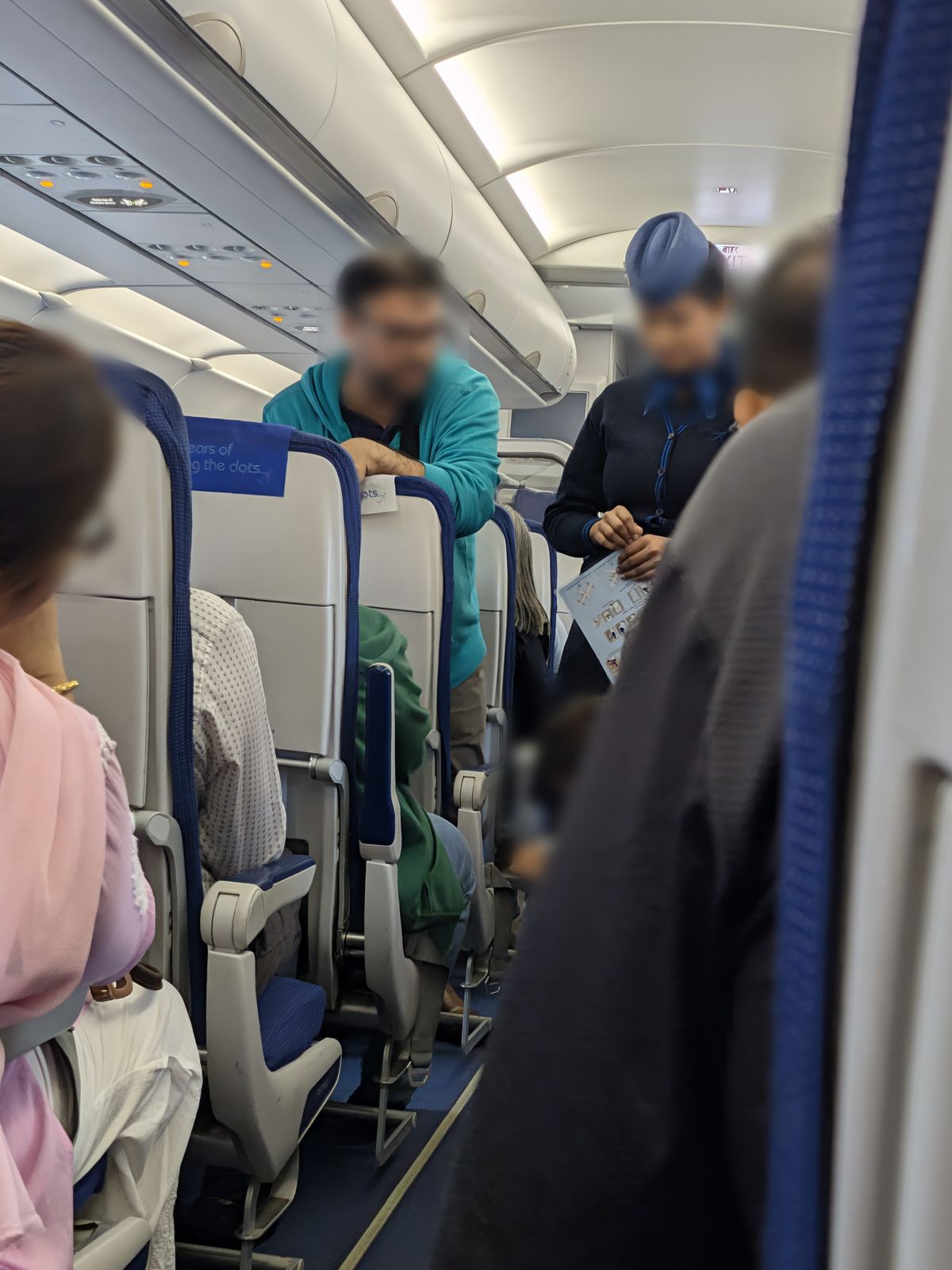
IndiGo flight 6E 235 from Kolkata to Bengaluru was delayed before departure on Thursday, 19 November, after a disagreement over where a family travelling with a patient on medical oxygen and an infant should sit, according to a passenger on board who shared the account and a photo with 150Knots. The flight was scheduled to leave Kolkata at 12:05 local time.
What Happened on Board
The family was travelling with a patient who needed an oxygen cylinder, which had to be placed next to the patient’s seat, as well as an infant. According to the passenger, the captain decided on a specific seating arrangement for the group, but the family did not initially agree to it.
The discussion held up the flight as crew members worked through the seating with the passengers in the aisle. As the delay grew, the family was eventually asked to move to the seats the crew had allocated so the flight could proceed.
150Knots has not been able to independently confirm the account with IndiGo, including the length of the delay or the exact reason behind the seating decision.
Why Seating Matters With Oxygen and Infants
Seating for passengers travelling with medical oxygen is not just a matter of preference. Airlines generally require oxygen equipment to be stowed securely and kept clear of aisles and emergency exits, and passengers using it are not allowed to sit in exit rows.
Infants add another layer. On narrowbody aircraft, each block of seats has a limited number of spare drop-down oxygen masks, which is why airlines restrict how many lap infants can sit in a single row or section. When a group includes both an infant and a passenger with medical oxygen, crews often have to rearrange seats to satisfy both requirements.
Under aviation rules, the pilot in command has final authority over safety matters on board, including seating decisions. Passengers who disagree can raise the issue with the crew, but the aircraft cannot depart until the arrangement meets the captain’s requirements.
What Passengers Can Do
Families travelling with medical equipment can avoid last-minute disputes by informing the airline in advance, completing any medical clearance the carrier requires, and asking for seats to be assigned before boarding. IndiGo, like other Indian carriers, has specific procedures for passengers who need medical assistance or oxygen during a flight.
For the other passengers on board, the episode meant an unplanned wait at the gate. It also shows how a seating decision that looks routine can carry safety requirements that are not visible from the cabin. Earlier this week, an IndiGo A321neo rejected its takeoff at Mangaluru, with all 236 people on board deplaned safely.
Have you witnessed an incident on a flight? Share it with 150Knots.