

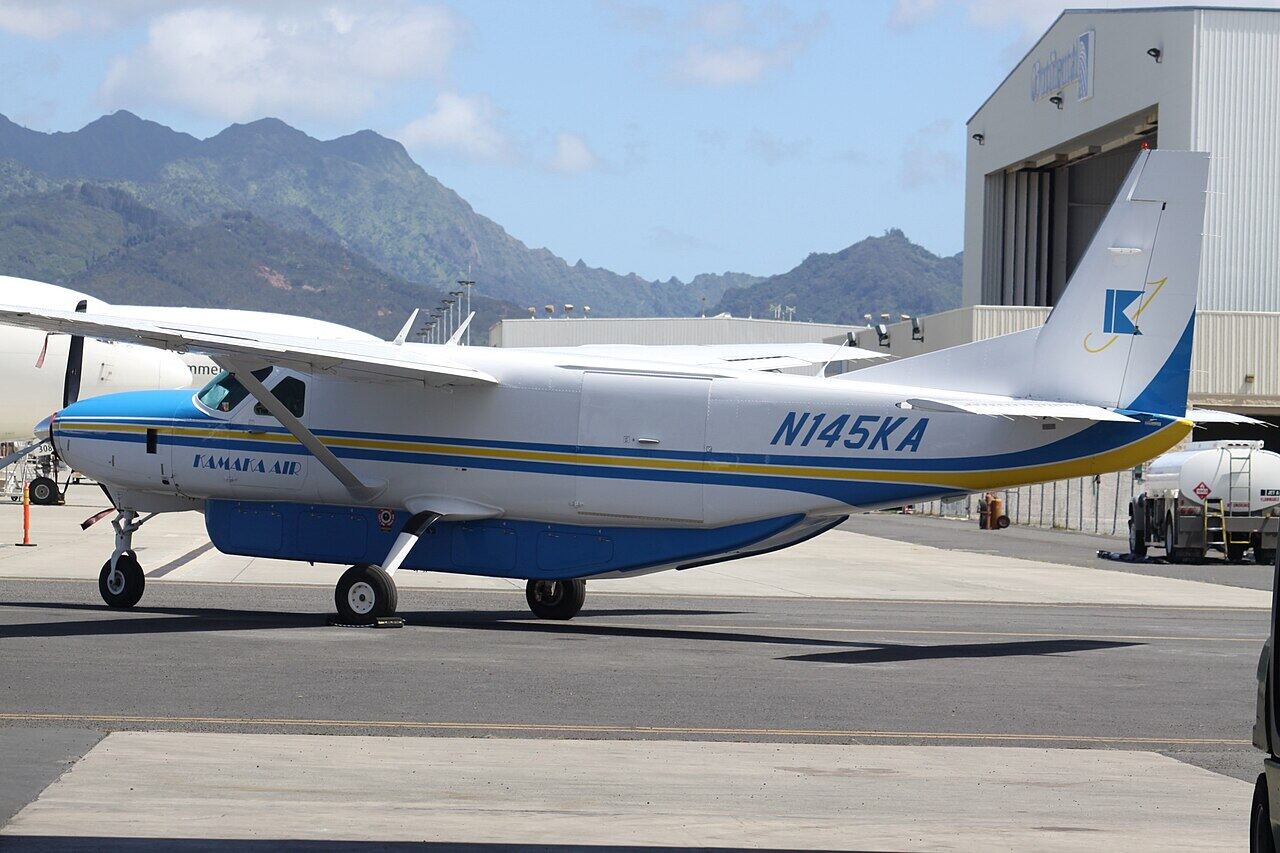
The US National Transportation Safety Board (NTSB) has found that improper maintenance led to the December 2024 crash of a Kamaka Air Cessna 208B Grand Caravan in Honolulu, Hawaii, which killed both pilots on board. The board’s final report, published on 20 November 2026, says a component in the aircraft’s flap system failed, leaving the aircraft in a roll from which the crew could not recover.
The aircraft, registered N689KA, crashed on 17 December 2024 shortly after departing Daniel K. Inouye International Airport on an instructional flight to Lanai. It struck a vacant state-owned building near the airport. The two commercial pilots on board, Hiram deFries and Preston Kaluhiwa, were killed.
What the NTSB found
According to reports on the final report, the NTSB determined that the probable cause was the failure of the left interconnect rod in the flap system, due to preload from improper maintenance. That failure produced an asymmetrical flap condition and an uncommanded roll to the left at an altitude too low for the pilots to recover, the board found.
The board also named contributing factors. It found that Kamaka Air’s failure to follow its Federal Aviation Administration (FAA)-approved maintenance programme, and inadequate training and supervision of its mechanics, contributed to the accident, the Honolulu Star-Advertiser and other outlets reported. The report says the company’s mechanics had received no formal training and learned their work by shadowing colleagues.
Maintenance history
Investigators examined the aircraft’s flap-system maintenance in the months before the crash. About 10 weeks before the accident, the company replaced the aircraft’s primary flap motor after a pilot reported that the flaps had failed to retract after landing, according to the report as described by aviation outlets.
Records showed that the operator had carried out replacements of only the primary flap motor on several of its aircraft between 2013 and 2024. After the accident, incorrect flap-system tension was identified in four of the six other Cessna 208-series aircraft that were checked. Kamaka Air subsequently corrected those discrepancies, the report states.
Unlike its report on the fatal Bering Air Caravan crash in Alaska, the board did not include FAA oversight in its statement of probable cause for the Kamaka Air crash.
Background
Kamaka Air is a Honolulu-based operator of Cessna Caravan aircraft. The company paused operations after the crash while it carried out precautionary inspections of its fleet.
The NTSB’s preliminary report, released in the weeks after the accident, did not set out a cause, and investigators said at the time that their work would include examining when the aircraft had been maintained and what work had been carried out. The investigation was complicated by the post-crash fire, which destroyed much of the wreckage.
The final report closes the federal investigation, docketed by the NTSB as ANC25FA010. NTSB reports are intended to identify safety lessons and are not used to assign legal liability.
Featured image: Photo: Aeroprints.com / Wikimedia Commons, CC BY-SA 3.0 (file photo)